How To Become the Boss Everyone Wants To Work For.
Manager: a person who has control or direction of an institution, business, etc., or of a part, division, or phase of it.
Evolution: any process of formation or growth; development.
Revolution: a radical and pervasive change in society and the social structure
I was listening to a teleclass from Linda Bernardi from the Bernardi Leadership Institute and she said the word “leader” should be changed to “collaborative influencer.” The word leader, she said, brings up old experiences with authoritarian types, and that’s not what a leader should be today.
Leaders today, she emphasized, need to be able to engage their constituents in a cooperative manner with the intent to create an awesome customer experience together. A leader today needs to take advantage of the two-way conversations and transparency that social media channels provide. In this case, they need to be able to effectively text and blog, Facebook and Twitter, and do whatever it takes to interact honestly with their constituents: customers, employees, investors, lenders, vendors.
I don’t think a two-syllable word is going to be replaced by a nine-syllable one, but I understand what she is saying. There is a shift going on. Leaders are being forced, due to the internet and it’s social media channels, to be more transparent. If they want their company to be taken seriously by their customers and themselves to be respected by their employees, then they need to know how to engage with them on their terms.
Many of my clients eschew these modern avenues of communication. They say they don’t have the time, are not interested, and/or don’t like the lack of privacy. However, social media is not going away. It is getting bigger. They need to know that to be an effective leader today, they need to be able to carry on relevant conversations that show their knowledge of their topic, and their interest in their constituents.
A leader today needs to be a collaborative influencer both face to face and virtually. These skills are essential . The very definition of a leader is one who influences. And others won’t allow themselves to be influenced – or can’t – if communication is not in the form they use and expect.
Does your CEO use social media effectively – to influence collaboratively? Do you? How important do you think it is for your organization’s leaders to be able to use social media effectively in order to build trust, respect and business?
I just received an email with the subject line ‘Checklist for Terminating an Employee’. It turned out to be an advertisement for a book called From Hello to Goodbye. For some reason, although the book is about the entire work span of an employee, the only chapter that was mentioned in the message was the one on how to “terminate the employment relationship”.
This how-to chapter was the sole selling point for the entire book. The email came from the Society for Human Resource Management, so it is intended for HR professionals.
Although I’ve never been “fired” per se (although one insensitive career counselor moved a colleague to tears when she told our group of newly separated workers that being laid off was the same thing as being fired), I have been laid off several times and each time the process was handled very differently. No matter how Human Resources, legal departments or senior management define the termination process, the ultimate responsibility for how the separation is actually handled rests with the worker’s manager.
The coldest, most impersonal layoff I experienced was probably done according to the above-mentioned Checklist. My boss had been distant for some time. When he called me into his office where another manager was sitting, I immediately knew this was it. It offended me that he felt he had to have a witness. Without any emotion, he said he’d decided to outsource my position, explained my severance package, and asked that I pack my things and leave that afternoon. This was the least sensitive layoff I’d experienced, and the one done most “by the book”. My boss was Vice-President of Human Resources.
The most humane termination experience I had was the time my boss defied the HR rules. My supervisor rounded up our team of four and said, “I’m not supposed to tell you this, and you can’t tell anyone else. But lay-offs are going to happen next week and all of you are among them.” She then took us out to lunch and gave us the rest of the day off to “go sign up at the unemployment office”. It was a Friday and on Tuesday of the next week, dozens of people were called into a large room and told en masse that their jobs were eliminated. Stunned co-workers wandered the halls, but gratefully, we weren’t among them.
In the second example, some will say my boss acted rashly and laid the company open to possible lawsuits by doing what she did. But my opinion was she was a very smart leader. First, she knew us well and knew that getting laid off would be a hardship for us. She wanted to give us the news in as helpful and human a way as possible. She showed empathy and concern.
Second, studies have shown that ensuring the dignity of terminated workers goes a long way toward heading off lawsuits. One study of displaced employees found that 15 percent of workers who felt their severance experience lacked dignity or respect had filed wrongful termination lawsuits.
Honesty, sensitivity and caring for an individual help mitigate the devastation of layoffs. As a leader, you must take care to make clear, fair and informed choices about which employees to let go and which to keep. By being transparent about how the decisions are made, and making an effort to over-communicate the what, why, and how of the layoffs, you are showing your employees respect.
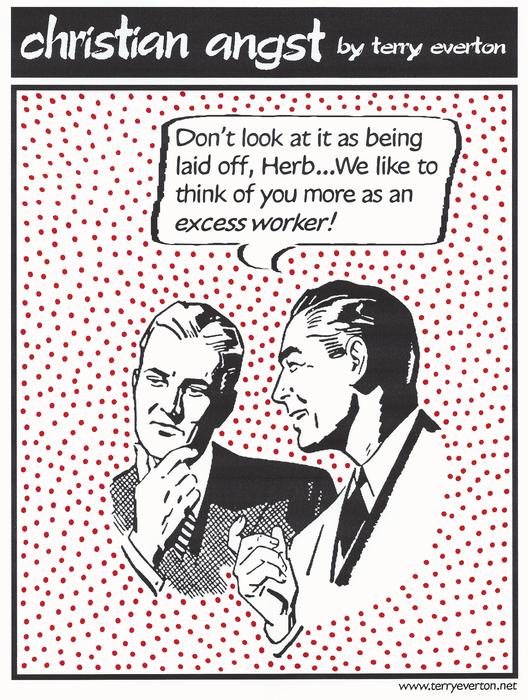
One study reported that losing one’s job created more stress than a divorce. It doesn’t matter which euphemism is used – downsizing, rightsizing, workforce reduction, delayering, made redundant, releasing, and on and on – if you are laying people off, you are the instigator of perhaps one of the biggest stressors of your employee’s life. That’s a lot of weight to carry.
When feeling stressed, it’s common to make more errors and to react emotionally. If you serve as an example of calmness and empathy during challenging times you can help spread that behavior. The worst situations are an opportunity to reveal the best in you.
Unemployment is still high and the news in the last week reminds us that cutbacks are continuing. Unfortunately employee layoffs are one of the primary management tools used to increase efficiency and reduce expenses. Bank of America announced over 30,000 layoffs in the coming year. You just need to check Daily Job Cuts or the BLS site Mass Layoff Statistics to see the gloomy updates.
It’s not easy to be the one to communicate a termination or to be among those left behind. By choosing behaviors that show respect and caring, especially when times are very difficult, you have an opportunity to illustrate true leadership qualities.
“At the heart of leadership is caring. Without caring, leadership has no purpose.”
– James Kouzes and Barry Posner, Encouraging the Heart
A new euphemism: "We have to synergize backward overflow."
A good manager is also a good coach. But what if your team is a virtual one, spread out in different cities or countries? A lot of leaders with virtual teams choose to ignore that part of managing and prefer to focus their precious time on their projects, not their people. It is definitely taking the easy way out, but when their companies don’t particularly reward efforts at employee development you can’t blame these managers much.
Being good leaders, we know this is short-sighted, especially when there is a dearth of good leadership which is only going to get worse as people switch organizations, opt out of corporate work, or retire.
Developing future leaders starts with being a great coach to them. Building trust and respect is the foundation of coaching. I know your time is limited but adding a few minutes to your schedule should pay off when you don’t have to spend time onboarding a new hire after your employees quit for more enticing opportunities. Here are a few suggestions for developing trust and respect and for coaching those remote employees:
• Talk one-to-one via the telephone to each direct report periodically. Include a little “personal time” talk to find out what they did during the weekend, how their family is doing, and milestones for them and their kids. Write down their kids’ and spouses’ names and important facts like their hobbies or birthdays. Put the birthdays and other milestones into your calendar.
• Be sure and send a text or email message acknowledging those milestones when they come up in your calendar. Follow up with questions about events and people that are important to them. Your direct reports will be impressed that you remembered or cared. This is all about relationship-building.
• Listen carefully during conference calls and take notes. Listen to how your employees communicate and interact, ideas they may present, or priorities they focus on. Listen first of all for things you can reinforce with a little praise and appreciation. Listen second for things you can help them improve in order to be more successful. Respond immediately out loud on the call for the good stuff. Call them later for a ‘coaching to improve performance’ conversation for the other.
• Stay collaboratively influential with social media. Be sure your team has a Yammer or Sharepoint site, or even a Facebook page where you can share ideas and observations with each other. Besides messages about the projects your team is responsible for, this allows you an open forum for team coaching.
Studies have shown that 5:1 is the “magic ratio” for optimum relationships. That means in order to develop and maintain good relationships (whether personal or professional), there should be a minimum of 5 positive interactions to every negative one. That’s even more important to keep in mind when you can only communicate virtually. Just talking about business all the time is neutral, and not necessarily a “positive interaction”.
How to manage performance and coach employees to develop is a challenge when it’s face-to-face, much less virtually. Managers need to be even more vigilant and observant in order to detect those teachable moments and identify those coachable direct reports. But if you don’t want your people to jump ship at the next opportunity, you need to be the boss they want to work for. That means helping them be successful in their current work and coaching them on how to be ready to advance in their careers. No matter where they are.
How do you build trust and respect with your virtual team members?
Communicating with your remote team members can have unforeseen challenges.
Twenty years ago I worked at a company that was and still is known as one of Fortune Magazine’s 100 Best Companies to Work For. My department and most of the people I worked with were fun and supportive. We worked hard, had a chance to be innovative, and were appreciated for our efforts.
But one department that I had to work with on a regular basis was a nightmare for me. In fact, the department was so difficult to work with that it had acquired a nickname in the company - the “Estrogen Explosion”. Needless to say, the top two or three people from the vice president on down were women who perpetuated the B-word. And I don’t mean boss.
I had many run-ins with these women and I often left our bi-weekly meetings feeling frustrated and put-down. My own boss, a very nice man, didn’t have a clue as to how to work with them effectively and so I didn’t receive any coaching on how to deal with their behavior.
I tried everything I could think of to improve the situation. I hosted appreciation events with both of our departments to strengthen working relationships. I tried holding my ground and talking sternly back to them when they got on my case. I tried letting their sarcasm and snide comments wash right over me without reacting. In the end, they “won” as I left the company, feeling exhausted and somewhat abused. My nice boss had left two years earlier and had been replaced by one not so understanding or supportive. Between him and the constant stress from working with the Estrogen Explosion, I needed a long break and I took it.
I was one more person who left a good job with a good company due to poor leadership.
Do you know what your department’s reputation is? Is your team known for being easy to get along with, knowledgeable, and high-performing? Or do other employees dread inter-departmental meetings with your people?
I have experienced both extremely collaborative departmental cultures and the opposite. Sometimes the team is on the whole very cooperative except for one odd person who is insecure or competitive or both. Leaders set the tone - they reinforce the values which become the culture of their areas. If they are competitive, secretive, and power-mongering, then their organization will tend to be the same. If they keep themselves and others accountable to a higher set of behaviors, then those will morph into the culture and reputation of not only their department, but will become their signature leadership qualities as well.
As one (and not the only one) of the casualties of the Estrogen Explosion, I observed first-hand the different leadership styles and their effects on the people around them. This experience was one of the catalysts for changing my career from international sales and marketing to a coach and consultant. So I did get something positive from that prolonged ‘learning experience’. And I pass my hard-earned wisdom on to anyone who needs it.
From my position now as a leadership coach and trainer, I know that there were things I could have done at the time had I known of them. I can see that my behavior style was a direct opposite of the vice-president’s and her manager’s. Had I known then what I know now about flexing my behavior style, I could have mitigated the confrontations to some extent. Roles, responsibilities, and expectations should have constantly been reviewed because there was overlap between our two departments that also contributed to the conflict. And, my nice boss also had a behavior style which was in conflict with theirs. If he had understood what I do now, he could have coached me on quite a few options to try in order to improve circumstances.
What values are you reinforcing? What behaviors do your employees see you employing, especially when circumstances are stressful? Are you keeping others accountable to high behavior standards or do you let them get away with (seemingly) minor transgressions as long as you get the results you want? What you say and do ends up affecting your entire organization, but most of all, it affects you and your direct reports. Find out what your department’s reputation is, and if you want to change it, it starts with you.
In a study of over 29,000 men and women in the U.S. workforce, it was determined that 18% of men and 16% of women have personality disorders that cause them to deviate from societal norms when interacting with others. The most common of these personality disorders, in order, were obsessive-compulsive disorder (OCD), anti-social behavior, and paranoia. (Contrary to how the layperson usually defines it, anti-social behavior refers to behaviors such as lying, cheating and stealing.)
Personality disorders are less serious mental illnesses than diagnoses such as depression or bipolar disorder. But they do cause difficulties for the afflicted and those around them. Employees with personality disorders lost their jobs at about double the rate of those without disorders, and experienced serious problems with bosses or co-workers three times as often.
This study, published in the January, 2011 edition of the journal Industrial Relations, might explain any “difficult employees” you have. It seems every office has at least one. Obsessive-compulsive disorder is the most prevalent and usually the least offensive. I know my exercise teacher exhibits that at every class: when others try to help her take down equipment after class she gets upset when they put away things in the “wrong” place or wrap up cords and things the “wrong” way. If they try to help her by setting up chairs she will rearrange them so they are “just so” – alternating sets of two and three along each wall. We old-timers have learned not to help her and she appreciates that.
At work, these common personality disorders may show up as interpreting emails in distorted ways, taking innocent comments as personal insults, refusing to accept different ways of doing things, or seeing conspiracies where there are none. And of course, lying, cheating and stealing.
Although one of my clients told me, “Managers have to be psychologists!”, you really don’t have to be the one to make a personality disorder diagnosis, nor should you be. However, you should be alert to these types of behaviors so you can work with the individual in the best possible way. Just because someone has a personality disorder doesn’t mean they can’t still be a very valuable employee.
As with any employee, here are some management approaches to keep in mind:
• Assign responsibilities that may take advantage of their disorder’s challenges: for example, have them proof outgoing communications to ensure benign interpretation and proper procedure.
• Allow them to redesign tasks to fit their work styles.
• Ensure that your professional expectations are clear and hold them accountable when they don’t meet them.
• Understand that they may work best independently and try to assign responsibilities that allow them to do so.
• If there are repeated negative encounters with no improvement, yet the employee meets work output expectations, encourage them to take advantage of the Employee Assistance Program or other health benefits your employer may provide.
• Again, if there are repeated negative encounters with no improvement, it may be wise to consult with your legal and human resources departments to understand how best to deal with individuals with mental health challenges, and how to screen for them when hiring.
No one chooses to have a personality disorder. Diagnosed personality disorders are covered in the United States by the Americans with Disabilities Act, and are treatable.
The researchers estimate that their study results showing 17% of the workforce struggling with a personality disorder is probably low. Like my coaching client said, managers do need to be somewhat of a psychologist in order to be able to manage people effectively. It’s important to be aware of common psychological challenges that your employees may be dealing with and to have some options for managing them.
In this blog, I give a lot of advice. I am a teacher at my core and I like to share tips that will help others. This blog is a great outlet for me, because when I am in “coach” mode, I turn the advice off.
The best coaching is the kind that helps the other person access their own wisdom. (I know, doesn’t that sound wise?) The best coaching means asking questions that help the person clarify their thinking and consider looking at things in a different way. The best coaching helps them become a better thinker, a better solution-finder, and allows them their own “ah-ha” moments that really don’t happen when someone else tells them what to do. The best coaching allows people to transform into their better selves through the simple act of asking questions and listening.
Sure, occasionally a client is “stuck” and insists on getting some answers from me. I try to be careful with this. I offer suggestions and tips that may or may not work for them, giving them the ultimate choice about whether to try them or not. After all, they are the only ones who are walking in their shoes, and they are the only ones who know whether something will work for them or not. And, taking another’s advice is often not very motivating so it is bound to fail when they don’t follow through on it. (And then they may blame the advice-giver.) However, if through questioning and coach-guided pondering, they come up with the answers on their own, they will be more inspired to follow through on what they’ve come up with.
The exact same reasoning applies to your employees. Too many managers believe that being a strong leader means knowing the answer. Leaders think that is what they are there for, to provide solutions. They jump in with the answers when their employees come to them for help. Unfortunately, by providing the answers, they are keeping their employees from developing, and therefore keeping their organization from developing healthily too.
Providing answers trains your employees not to think or be creative. It trains them to stay dependent and when people feel dependent, they feel held back, repressed, and powerless. Sounds like a mix that generates low morale and low motivation, doesn’t it?
A client recently told me that one of the most significant behavior changes he made as a result of coaching was to pause and ask questions of his employees instead of providing answers and advice. Because of this one conscious change, he said it has allowed him to be more transparent, sharing what he doesn’t know or understand, and has allowed him to learn about new issues. “If I slow down,” he said, “I can get some meaningful responses. Sometimes it validates what I already know, but it really helps me get buy-in. Before, I would just tell them. Now, I listen first and talk second. I am less of a policeman, less of a controller; I just let things happen more and don’t try to control them. I am more into the moment - building dialogue and connections."
Wow – building dialogue and connections. What a great way to develop and motivate his staff.
One thing that works for every person whether they are manager or individual contributor, parent or friend, is listening first, asking questions second, and offering advice as a last resort, if at all. Think about how much advice people give you. How much of it do you actually take? What if, instead of offering you advice on what to do in a situation, they walked you through thinking through the problem to find a solution? What if they asked questions like:
What outcome do you really want?
What do you need to do to take the next step?
Would it help if I acted as your sounding board as you went through possible next steps and their scenarios?
What resources do you have right now that can help you with taking the next step?
What is in your way that is impeding your progress?
How would achieving your goal affect you and the people around you?
Questions like these help the listener focus on the solution instead of the problem. They help the other person develop their own problem-solving skills and determine and commit to next steps without getting overwhelmed.
Sometimes people come to you with a problem and they don’t want your advice or to be walked through to a solution on their own. They really already know the answer; they know what they have to do. But they just want to vent. That’s okay. You may need to ask: ”Do you want to talk through a solution to this or do you just want to vent?” If it’s vent, let them complain for a few minutes. Everyone needs to let off steam once in a while. The best bosses allow their employees to come into their offices just to vent for 3 minutes. That’s enough. Let them know they can come in to let off steam with no repercussions any time. Empathize, then send them on their way.
Leaders have to realize that employees, especially younger ones, probably need to be retrained in order to think for themselves. For their whole lives, from childhood through college, their parents and their teachers have told them what they should be doing. Rarely do parents and teachers teach them how to think for themselves, as students are rewarded for the “right answers” and kids are rewarded for “minding”. Now they are employees and you, their manager, are just like their parent or teacher. They want to please you so they want to do what you want them to do.
What you want them to do is think for themselves, be creative, and be solution-oriented. Listening to them, asking them questions, and coaching them will help them become motivated and productive knowledge workers.
So next time someone comes up to you with a problem, resist the initial urge to give them advice. Pause and ask a question. “What do you think? What do you want the end result of this situation to be? What can be done to get there? How does that work?” Give your employees their own power back. They hold the best answers to their own problems.
The other day before leaving for a hike I asked my boyfriend if he had his water bottles with him. He said “Yes, I have my water bottle.” I said “No, water bottlesssss. Plural. Do you have them with you?” “Yes”, he said.
We drove for a couple hours to the Summerland trailhead in Mt. Rainier National Park. We laced up our hiking boots, and I swung on my daypack. He fished a bottle out of his car trunk and stuck it in his pack. “Where’s your other bottle?” I asked. “It’s in the back seat, but it’s empty.”
Now, did I make a point of asking him if he had more than one water bottle before we left the house? Yes.
Did I ask him if he had filled both water bottles? No.
Stupid me. I thought it was understood that water bottles would be filled with water before an 11-mile hike up the side of Mt Rainier.
I had two full bottles of water. He had – one half a bottle. Yes, that’s right, the bottle he stuck in his pack was only half full. It had been sitting in his car for a month. Before we left the house he had not bothered to bring his bottles in and fill them. Apparently, it was too much trouble to wait for my Brita pitcher to refill after I had emptied it into my water bottles. On the Summerland trail, there is a bubbling creek, Panhandle Creek. His solution was “I’ll get some creek water and boil it for tea.”
I was livid. “You can’t drink that on the trail! I’m tired of holding back on my water intake! The last 5 or 6 hikes we’ve been on you haven’t brought enough water and I feel like I have to ration myself! And so do you! Why do you think I asked you specifically if you had water bottles with you???!!!”
He was extremely apologetic and for the rest of the hike made a point of thanking me every time I offered him a drink from one of my bottles. (Making me feel small and mean, especially when I had water left over at the end of the hike.) Since then, he's always brought his own two full bottles of water on our hikes. He learns quickly. Plus he’s the best man I know.
So did we have a “fly-by”? Was that “unclear expectations”? Or was he just not listening to me? This last possibility was the one that made me the angriest. The first two possibilities implied that I was partly to blame too, which I really didn’t like to consider.
But, hard as it is, I have to admit: I didn’t make my expectations clear. He answered my question truthfully: yes, he did have two water bottles. I didn’t explicitly state that I expected them to be full of water. Difficult as it may be to understand how my question could have been misinterpreted, this kind of thing happens all the time.
What’s obvious to you is obvious to you. You know what they say about making assumptions. You may not have the best man like I do, who takes the blame, accepts the feedback, and says “You’re such an amateur when it comes to getting mad.”
So be proactive: be clear. Get confirmation that what you are expecting to happen is understood the way you understand it. Make your expectations crystal clear.
Without expectations that are understood and bought into there is no basis for coaching. No basis for asking for accountability. And certainly no basis for blame, recriminations or punishment.
It is the team leader’s responsibility to set clear expectations and ensure that they are understood. And it is the team leader’s and the organization’s responsibility to provide the resources, training and support needed to carry out those expectations.
• Clarify the discrepancy between what there is now and what is wanted.
(I should have done this at the house. “Do you have two full water bottles? The last few hikes I felt I was rationing water so I want to make sure we each have enough. This is going to be a fairly long hike and it’s important to be well-hydrated. Ten essentials and all that, you know.”)
2. Are specific and concrete.
• Isolate the desired behavior and results.
• Clarify the measurement.
• Establish time frame.
(“Let’s fill up all four water bottles right now before we go.”)
3. Are realistic.
a. Provide a challenge
b. Can be achieved
c. Are within the control of the employee
(“I know you have to go get them out of the car and wait till the Brita refills. Kind of a drag, but we have time. Or, you can just fill them up with tap water.”)
4. Are confirmed.
• Ask the individual to verbalize what he or she understands the expectation to be.
(“I want to make sure we don’t have any fly-by’s. I want us each to have two full bottles of water for the hike. Are you with me?”)
As a trainer and consultant, I know how important it is to explain the “why” behind an expectation or request. I do it at work. I explain to clients how to do it, and of course, why to do it.
Yet, here in my personal life a simple why up front could have prevented a whole lot of grief, mainly my own!
Why was I asking if Bart had more than one water bottle?
Only I knew. If I had cared to make the effort to share why, I’m sure Bart would have gone the extra few steps to fill his bottles. The same rationale applies to your employees. For a more productive and happier workplace, don’t forget the 4 steps.
 What is a leader today?